
Quick answer: curcumin for joint pain has the best evidence of any supplement for knee osteoarthritis — meta-analyses of randomised trials consistently show it beats placebo. But the same research shows it is less effective than ibuprofen, trial quality varies, and plain turmeric powder is poorly absorbed. It is a reasonable, low-risk thing to try alongside exercise and weight management, not a replacement for them.
Before you buy a high-absorption curcumin
Our scorecard covers a liver safety warning that applies specifically to bioavailability-enhanced formulations – plus grades for 6 other joint supplements.
What this guide covers
- Turmeric vs. curcumin — not the same thing
- What the trials actually found
- How it compares to ibuprofen
- The absorption problem
- Dosage and how long to try it
- How to read a curcumin label
- Safety, side effects and who should avoid it
- Can you just eat turmeric?
- Common questions
- The takeaway
Turmeric vs. curcumin — not the same thing
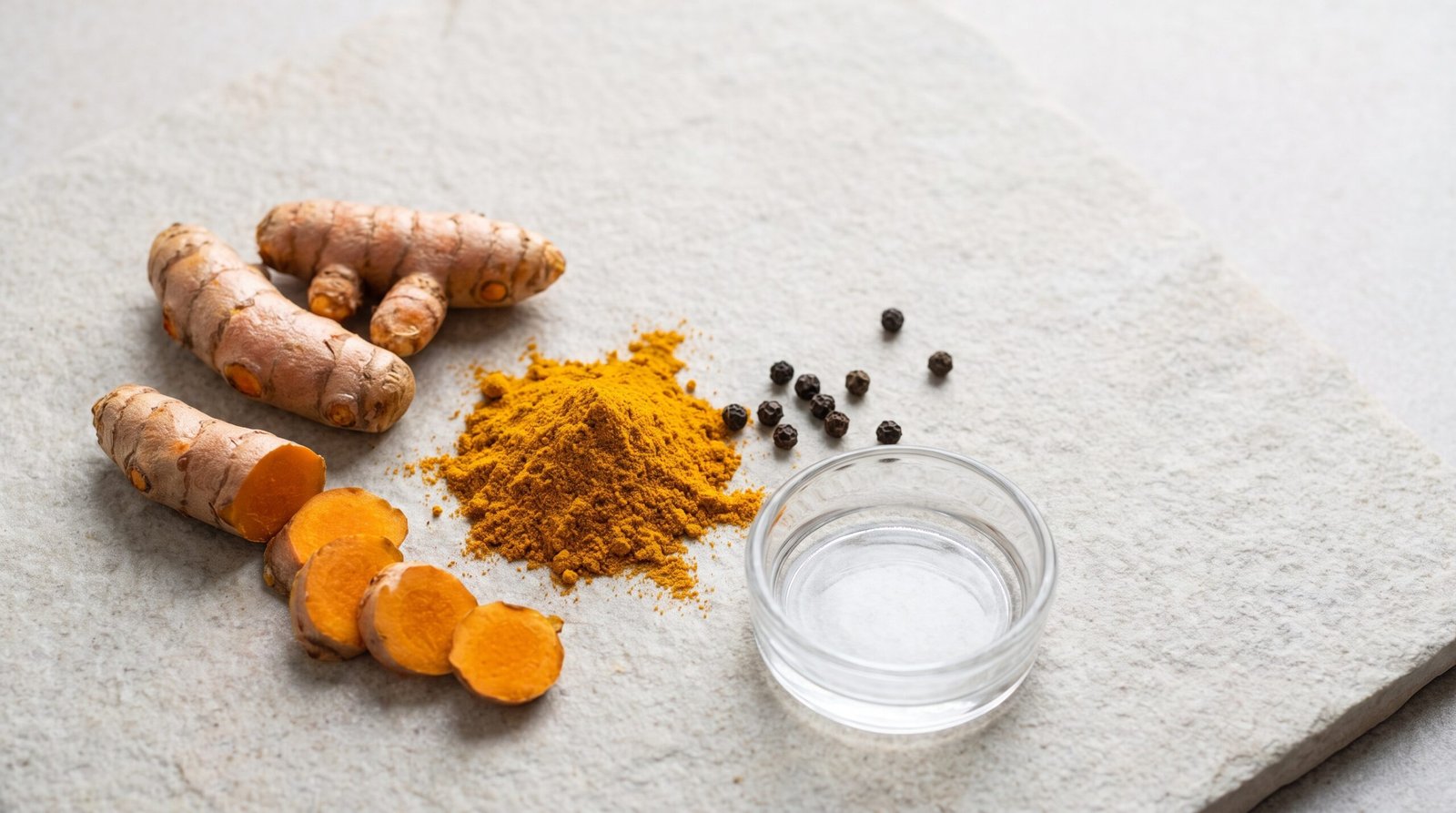
Turmeric is the root. Curcuminoids are the active compounds within it, and curcumin is the most studied of those. Crucially, dried turmeric powder is only around 2–5% curcuminoids by weight — so a teaspoon of turmeric contains a fraction of the dose used in research.
When a study reports benefit, it is almost always testing a concentrated curcumin extract, not culinary turmeric. Conflating the two is the most common mistake in this category, and it is why “add turmeric to your food” advice rarely reproduces trial results.
What the trials actually found (Evidence: Moderate)
Curcumin is unusual among joint supplements in having repeated, reasonably consistent randomised evidence.
A Bayesian network meta-analysis pooling 23 studies across 7 countries — 2,175 people with knee osteoarthritis — found curcumin significantly reduced pain on the visual analogue scale versus placebo (mean difference −1.63; 95% CI −2.91 to −0.45). It also improved the total WOMAC score, which captures pain, stiffness and physical function together (mean difference −18.85; 95% CI −29.53 to −8.76).
A separate systematic review and meta-analysis of randomised clinical trials reached the same direction of effect for knee pain and function.
The honest caveats: trial sizes are mostly modest, formulations differ between studies (making them hard to compare directly), study quality is uneven, and several trials were funded by supplement manufacturers. The effect is real in the aggregate; the precision is not as good as the headline numbers suggest.
How it compares to ibuprofen
This is the part supplement marketing tends to skip. In head-to-head analyses, curcuminoids produced significantly less pain relief than ibuprofen. Curcumin is better than nothing; it is not as strong as a standard anti-inflammatory.
Where it becomes genuinely interesting is tolerability. Trials reported no serious adverse events and suggested curcumin may reduce the need for rescue medication. For someone who cannot tolerate NSAIDs, or wants to reduce how often they reach for them, that trade-off — somewhat less relief, considerably fewer gastrointestinal and cardiovascular concerns over time — can be worthwhile. That is a decision to make with your doctor, not instead of them.
The absorption problem
Curcumin on its own is poorly absorbed, rapidly metabolised and quickly cleared — the central limitation on its usefulness. Manufacturers address this in a few ways:
- Piperine (black pepper extract). The most common and best-known approach. Piperine slows curcumin’s metabolism and improves absorption substantially. Studies typically pair roughly 20 mg piperine with around 2 g curcumin, or use 5–10 mg piperine alongside a supplement dose.
- Phospholipid/phytosome complexes. Curcumin bound to lecithin to improve uptake; used in several clinical trials.
- Nanoparticle and micellar formulations. Newer delivery systems, generally more expensive and less consistently studied.
An important caution about piperine: it enhances absorption of other compounds too, including medications. That is a real interaction risk, not a marketing footnote — see the safety section.
Dosage and how long to try it
Trials in knee osteoarthritis have commonly used roughly 500–2,000 mg of curcumin extract daily, often split into two or three doses with food (fat aids absorption). Study durations were typically 8–12 weeks.
Practical approach: give any trial at least 8 weeks before judging it, take it with a meal, keep the dose within the range used in research, and be willing to conclude it isn’t helping. Doses far above trial ranges are not better supported — they are simply less studied.
How to read a curcumin label
- Standardised curcuminoid content — look for the actual milligrams of curcuminoids, typically standardised to 95%. “Turmeric 1,000 mg” without a standardisation figure tells you very little.
- A stated absorption strategy — piperine, phytosome or a named delivery technology. Without one, absorption is likely poor.
- Third-party testing — independent verification of contents. Supplements are not pre-approved for label accuracy before sale.
- Realistic marketing — any product promising to “cure arthritis” or “rebuild cartilage” is telling you about the company, not the science.
Safety, side effects and who should avoid it
Curcumin is generally well tolerated, and serious adverse effects have not been reported even at high doses in research settings. The most common complaints are mild: stomach upset, reflux or loose stools, which often resolve on lowering the dose.
Speak to a doctor or pharmacist first if you:
- Take warfarin or other anticoagulants/antiplatelets. Curcumin can reduce warfarin clearance, and warfarin has a narrow therapeutic index — small shifts can matter. Medicines regulators have issued explicit warnings about turmeric/curcumin products interacting with warfarin.
- Have gallstones or bile duct obstruction. Curcumin stimulates bile production and gallbladder contraction, which can be painful or problematic if the duct is obstructed.
- Are pregnant or breastfeeding, or taking diabetes medication (curcumin and piperine can influence glucose handling).
- Take any medication with a narrow therapeutic window — because piperine increases absorption of other drugs, not just curcumin.
Stop and seek advice if you develop abdominal pain, jaundice, or unusual bruising or bleeding.
Can you just eat turmeric?
Culinary turmeric is a genuinely good addition to an anti-inflammatory eating pattern, and cooking it with black pepper and fat is sensible. But reaching trial-level curcuminoid doses through food alone is not realistic — you would need far more than anyone eats.
So: enjoy turmeric as food for its own sake, and treat supplementation as a separate decision with its own evidence and its own risks.
Collagen peptides are the other joint supplement with comparable trial evidence — see collagen for joints.
Common questions
How long does curcumin take to work for joint pain?
Most trials ran 8–12 weeks. Some people notice change sooner, but judge it at around 8 weeks of consistent daily use.
Does curcumin repair cartilage?
No. The evidence is for symptom relief — pain, stiffness and function. There is no good evidence that it regrows or repairs cartilage, and products claiming otherwise are overstating the science.
Is curcumin better than glucosamine?
Curcumin currently has more consistent randomised evidence for knee osteoarthritis pain than glucosamine, whose trial results are notably mixed. Neither is as effective as exercise and weight management.
Can I take curcumin with ibuprofen?
Many people do, but check with a pharmacist — particularly if you take them regularly, have any bleeding risk, or take other medication.
Do I need the black pepper version?
Some absorption strategy is worth having, since plain curcumin is poorly absorbed. Piperine is the most common; phospholipid formulations are an alternative if piperine’s drug interactions are a concern for you.
The takeaway
Curcumin is the joint supplement with the strongest evidence behind it, and that evidence still puts it below ibuprofen for pain relief and well below exercise and weight management for overall benefit. If you want to try it: choose a standardised extract with a real absorption strategy, stay within researched doses, give it eight weeks, and check interactions first — especially if you take anticoagulants or have gallstones. Build the foundation first with our guides on reducing joint pain naturally and low-impact exercise, and see early signs of arthritis if you have not yet had your symptoms assessed. More in the Joint Health hub.
This article is for educational and informational purposes only and is not medical advice. Consult a qualified healthcare professional before starting curcumin, particularly if you take anticoagulants or diabetes medication, have gallstones or bile duct problems, or are pregnant or breastfeeding. Read about how we review content.
References
- Efficacy and safety of curcumin therapy for knee osteoarthritis: a Bayesian network meta-analysis. J Ethnopharmacol. sciencedirect.com
- Effectiveness of curcuminoids in the treatment of knee osteoarthritis: systematic review and meta-analysis of RCTs. PubMed 28470851
- Efficacy and safety of curcuminoids alone in alleviating pain and dysfunction for knee osteoarthritis. PMC9580113
- Medsafe (NZ) — Turmeric/curcumin containing products can interact with warfarin. medsafe.govt.nz
- Linus Pauling Institute, Oregon State University — Curcumin. lpi.oregonstate.edu