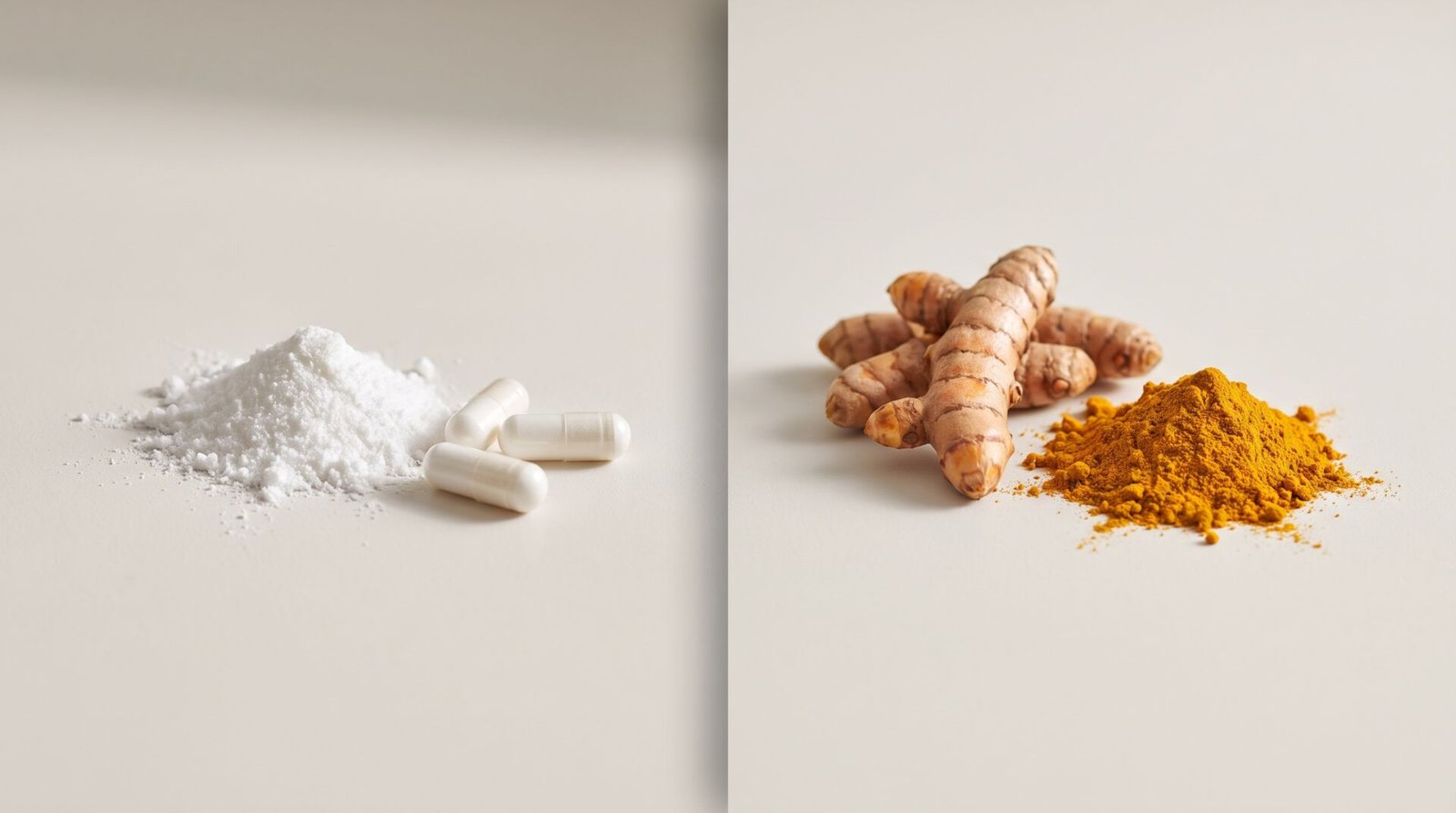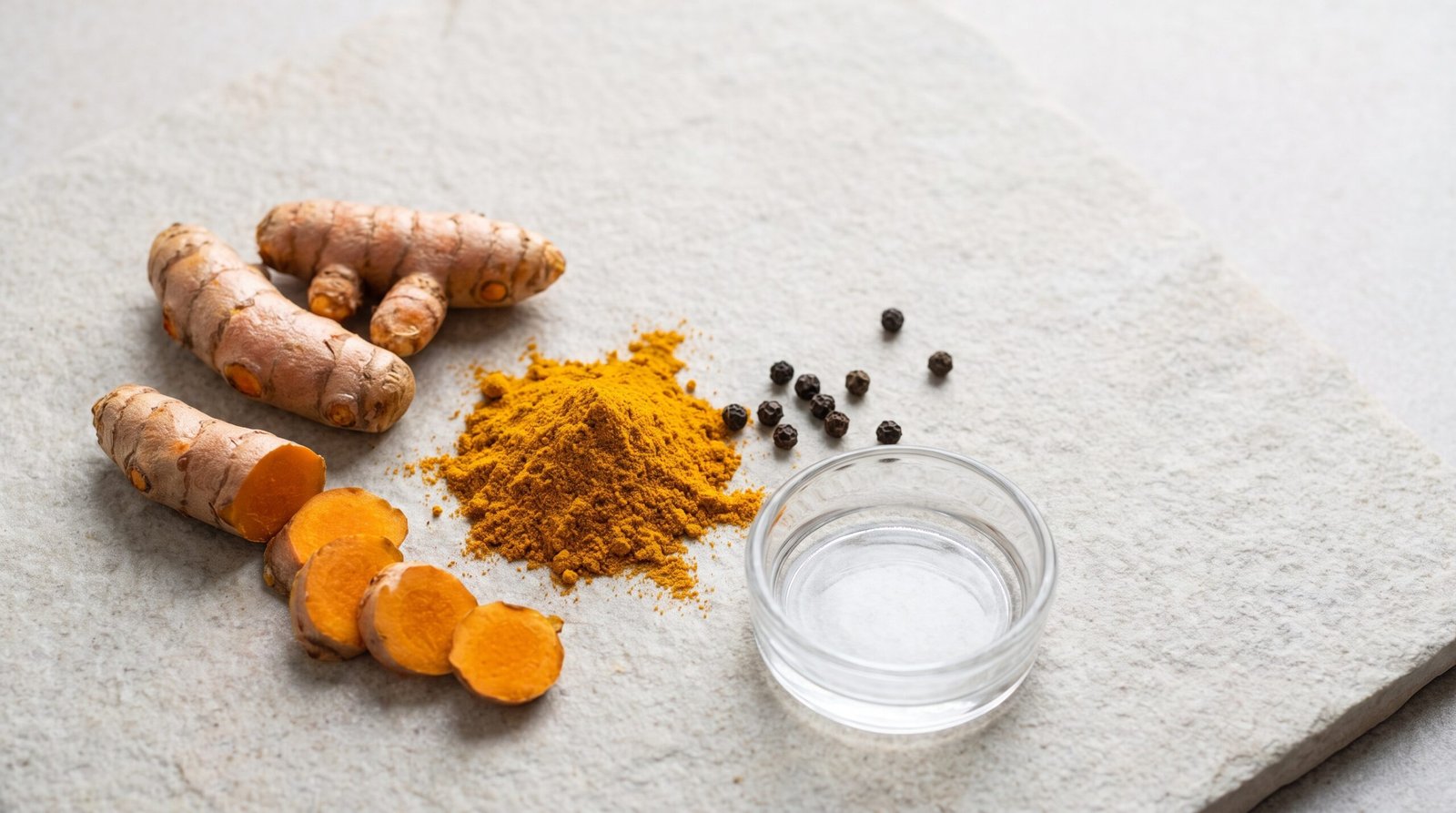
If you have already decided which ingredient you want to try, the next problem is the shelf. Two bottles both say glucosamine. One costs a few pounds, the other several times that. Knowing how to choose a joint supplement is mostly a matter of reading the label properly — and knowing what the regulations behind it do and do not guarantee.
This guide is about product quality, not about which ingredient has the better evidence. We cover that separately in our glucosamine and curcumin comparison.
This post contains one affiliate link (marked below). If you buy through it we may earn a commission at no extra cost to you — this never changes which ingredients or products we discuss, or how critically. See our affiliate disclosure.
This article is for educational purposes only and is not medical advice. Speak to a qualified healthcare professional or pharmacist before starting any supplement, particularly if you take prescription medication.
What this guide covers
What regulation actually covers, how to read the Supplement Facts panel, what a proprietary blend hides, how to compare a product against the doses used in research, and what quality seals verify.
Start with the ingredient, not the bottle
Product quality only matters once you have picked an ingredient worth buying. A well-made product containing something the evidence does not support is still a poor purchase.
So settle that question first. We review the evidence for curcumin, collagen peptides and glucosamine and chondroitin separately, and our evidence-grading methodology explains how we reach those grades. Everything below assumes you have already made that choice.
What FDA regulation actually covers
This is the single most misunderstood part of buying supplements, and it changes how much weight you should give the label.
According to the NIH Office of Dietary Supplements, medicines must be approved by the FDA before they can be sold. Supplements do not require this approval. The FDA also does not determine whether a dietary supplement is effective before it is marketed. Companies are responsible for holding evidence that their products are safe and that label claims are truthful — but unless a product contains a new dietary ingredient introduced after 15 October 1994, that evidence does not have to be submitted to the FDA beforehand.
Regulation is not absent, though. The FDA has established Good Manufacturing Practices covering the identity, purity, strength and composition of supplements, and it periodically inspects manufacturing facilities. NCCIH notes that the FDA also has authority to act against an adulterated or mislabelled product after it reaches the market. The Federal Trade Commission separately regulates advertising claims.
The practical takeaway: nobody verified that the product works before it went on sale. That is why the label, and who has independently tested it, carries so much weight.
Reading the Supplement Facts panel
Every dietary supplement carries a Supplement Facts panel. The NIH Office of Dietary Supplements describes it as listing the active ingredients, the amount per serving, and other ingredients such as fillers, binders and flavourings. NCCIH adds that manufacturers are required to list all of a supplement’s ingredients there — either in the chart itself or in the “other ingredients” list beneath it.
Two habits make that panel far more useful:
- Read per serving, not per bottle. The panel reports the amount in one serving, and a serving is often two or three capsules. A bottle advertising a large number on the front may deliver that only if you take several capsules at once.
- Check what form the ingredient is in. Related forms of the same ingredient are not interchangeable, and the form studied in trials is not always the form in the bottle.
ODS also notes that the manufacturer suggests the serving size — and that a healthcare provider might consider a different amount appropriate for you.
Proprietary blends: what they hide
A proprietary blend is a group of ingredients presented together under one name. Under FDA labelling rules, a blend must be identified as a proprietary blend and the total weight of all its ingredients must be given. The amounts of the individual ingredients inside it do not have to be disclosed.
Components are listed in descending order of weight, so you can tell which ingredient is most abundant — but not by how much. A blend listing eight ingredients totalling 500 mg could be almost entirely the first one.
This matters for one reason: if the individual amount is not disclosed, you cannot compare it to anything. That does not make a blend bad, and there are legitimate commercial reasons for using one. It does mean you are being asked to take the formulation on trust.
Checking dose against the trials
Here is a distinction worth holding onto: the dose used in a clinical trial is not a recommended dose. It is simply the amount researchers gave participants in a particular study. It has not been established as the right amount for you, and we are not suggesting a dose.
What it gives you is a reference point. If a product provides a small fraction of the amount used in a trial, it is not comparable to the research being used to sell it:
- Find the amount per serving on the Supplement Facts panel.
- Find the amount used in the trials for that ingredient — our individual ingredient guides report these.
- Compare the two, taking the serving size into account.
If the product is in the same range, the research is at least relevant to it. If it is far below, or hidden inside a blend, treat any claim resting on that research with caution. Discuss the amount itself with a pharmacist rather than deciding from a label.
Quality seals: what they verify — and what they don’t
Several independent organisations test supplements and let products that pass display a seal. The NIH Office of Dietary Supplements names ConsumerLab.com, NSF International and U.S. Pharmacopeia among them, while noting that mentioning an organisation is not an endorsement.
According to ODS, such a seal indicates the product was properly manufactured, contains the ingredients listed on the label, and does not contain harmful levels of contaminants. NCCIH describes third-party verification in similar terms.
The limit worth memorising. ODS states plainly that these seals “do not guarantee that a product is safe or effective.”
A seal tells you the bottle contains what it claims. It says nothing about whether that ingredient helps joint pain.
“This statement has not been evaluated…”
Supplement labels may carry claims that a product promotes health or supports a body part or function — joint comfort, mobility, flexibility. ODS explains that manufacturers are permitted to make these claims, and that they must be followed by a specific disclaimer: “This statement has not been evaluated by the Food and Drug Administration. This product is not intended to diagnose, treat, cure, or prevent any disease.”
That sentence is not boilerplate to skim past. When you see “supports joint health” alongside it, you are reading a permitted marketing phrase — not a finding.
A related red flag: any product implying it treats, cures or prevents arthritis has stepped outside what supplement labelling permits.
A five-question checklist
Before buying, run through these:
- Does the evidence support this ingredient at all? Settle this before comparing products.
- Is the amount per serving clearly stated? If it is inside a proprietary blend, you cannot verify it.
- How does that amount compare with the trials? Not as a target — as a reference point.
- Has it been independently tested? Remembering that this verifies contents, not benefit.
- Have you checked it against your medicines? A pharmacist can do this in minutes.
Working out which ingredient first?
Our free Joint Supplement Evidence Scorecard grades seven common ingredients — curcumin, collagen, omega-3, glucosamine, boswellia and MSM — against the clinical evidence, with the guideline disagreements and safety notes in full.
Worked example: running one real product through this checklist
To make the checklist above concrete, here is how it applies to one product we looked at, Joint Genesis, a capsule built around a branded, patented hyaluronic acid ingredient (Mobilee®).
- Does the evidence support the ingredient? Hyaluronic acid delivered orally has some human research behind it, including a study using an 80 mg daily dose — the same dose this product uses. That is a genuinely disclosed, checkable number, which is not always the case in this category.
- Is the amount per serving clearly stated? Partially. The core active (Mobilee) has its dose disclosed. Several supporting ingredients (French maritime pine bark, boswellia, ginger, BioPerine) are not fully broken out by individual amount — apply the same proprietary-blend caution from earlier in this guide to those.
- Has it been independently tested? The manufacturer states batches are made in an FDA-registered, cGMP facility with third-party testing for potency and contaminants — that verifies manufacturing, not effectiveness, exactly as covered above.
- Have you checked it against your medicines and situation? This step does not change per product — still worth five minutes with a pharmacist, particularly if you are on blood thinners or manage blood sugar.
We are not telling you this ingredient or product will fix your joint pain — the same evidence-based caution that applies to glucosamine, curcumin and collagen elsewhere on this site applies here too. What makes it a reasonable example to walk through is that its main active ingredient’s dose is actually disclosed and checkable, which is the exact quality the checklist above asks you to look for.
When the answer is “don’t buy any”
Sometimes the right decision is to leave the shelf alone.
NCCIH notes that while there is no cure for osteoarthritis, self-management strategies such as losing weight and increasing physical activity can help people manage symptoms. Those approaches are recommended more consistently across guidelines than any supplement. If you have not started there, that is where the effort is best spent first — see how to reduce joint pain naturally and our guide to low-impact exercises for joint pain.
There are also circumstances where a conversation should come before a purchase. ODS advises telling all your healthcare providers about any supplements you take, and getting their approval before taking supplements alongside or instead of prescribed medicines. It notes that some supplements can increase bleeding risk, or change your response to anaesthesia if taken before surgery, and advises caution during pregnancy and breastfeeding.
Two specifics relevant to joint products, both from NCCIH: glucosamine and chondroitin have been associated with an increased risk of bleeding in people taking the anticoagulant warfarin, and glucosamine may raise blood glucose levels in some people. ODS also cautions that “natural” does not always mean safe.
If your joint pain is severe, worsening, or accompanied by significant swelling, redness or fever, or it followed an injury, seek medical assessment rather than a supplement.
Common questions
Does a higher price mean a better joint supplement?
Not reliably. Price can reflect independent testing, the form of an ingredient, or simply branding. The checks above tell you more than the price does.
Are joint supplements approved by the FDA?
No. According to the NIH Office of Dietary Supplements, medicines require FDA approval before sale but supplements do not, and the FDA does not determine whether a supplement is effective before it is marketed. It does set manufacturing standards and can act against unsafe or mislabelled products already on sale.
Should I avoid every product with a proprietary blend?
Not necessarily, but you lose the ability to verify what you are getting. FDA rules require only the blend’s total weight, not the amount of each ingredient in it.
Does a USP or NSF seal mean the supplement works?
No. ODS states that these seals indicate a product was properly manufactured, contains what the label lists, and is free of harmful contaminant levels — but that they do not guarantee a product is safe or effective.
What should I tell my pharmacist?
The product name, the amount you plan to take, how often, and why. ODS recommends keeping a record of every supplement and medicine you take and sharing it with your providers.
References
- National Institutes of Health, Office of Dietary Supplements. Dietary Supplements: What You Need to Know.
- National Center for Complementary and Integrative Health. Know the Science: Tips on Reading Supplement Labels.
- U.S. Food and Drug Administration. Dietary Supplement Labeling Guide: Chapter IV. Nutrition Labeling.
- National Center for Complementary and Integrative Health. Glucosamine and Chondroitin for Osteoarthritis: What You Need To Know.