
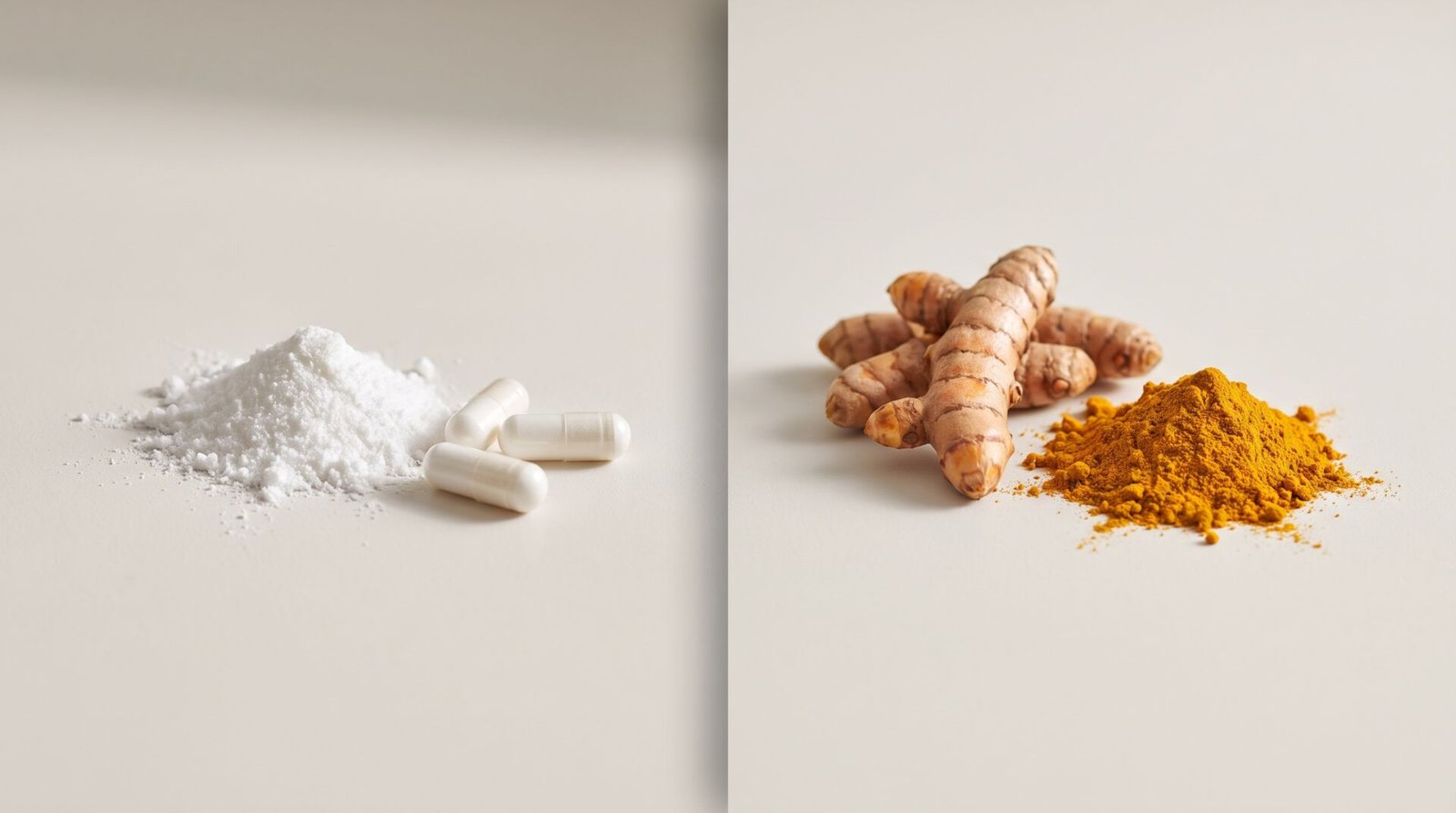
Glucosamine vs Curcumin: Which One Actually Works for Joint Pain? Two names dominate the joint-supplement aisle: glucosamine, usually paired with chondroitin, and curcumin, the active compound in turmeric. Both are widely sold. Both have been studied in humans. Neither is as settled as the packaging suggests.
This comparison looks at what the trials actually found — including the results that don’t favour either compound, and the places where expert bodies openly disagree.
This article is for educational purposes only and is not medical advice. Joint pain has many causes, some needing proper diagnosis. Speak to a qualified healthcare professional before starting any supplement, particularly if you take prescription medication.
The short answer
Curcumin has the more consistent short-term evidence for reducing knee osteoarthritis pain. Glucosamine and chondroitin have been studied longer and more extensively, but the results conflict — and the largest US trial found no meaningful benefit overall.
That said, curcumin’s most effective formulations carry a liver-safety caveat most articles skip, and neither compound is a treatment for underlying joint damage. Our source-grading methodology explains what these grades mean.
| Glucosamine + chondroitin | Curcumin | |
|---|---|---|
| Evidence for pain relief | Limited / mixed | Moderate |
| Evidence on joint structure | Inconsistent — trials conflict | Not well studied |
| Inflammatory markers | Not consistently demonstrated | Moderate — CRP and TNF-α reductions |
| Expert guidelines | Openly contradictory | Cautiously positive |
| Main practical problem | Inconsistent results | Absorption — and the liver risk of the fix |
What the glucosamine and chondroitin evidence shows
The defining study is GAIT, funded by the US National Institutes of Health — large, randomised, double-blind, placebo-controlled.
The headline result was negative. Glucosamine hydrochloride and chondroitin sulfate did not significantly reduce knee pain overall versus placebo. A subgroup with moderate-to-severe pain appeared to benefit, but the trial was not designed or powered to test that — such findings frequently fail to replicate.
On joint structure, the evidence genuinely conflicts. A 24-month GAIT analysis of 572 participants found joint space width did not differ between placebo and any treatment group. But a separate two-year Australian trial of 605 participants found the combination did reduce joint space narrowing, while either alone did not. Two further two-year chondroitin studies also found improvements.
These results contradict each other. Anyone telling you the cartilage question is closed — in either direction — is overstating what we know.
One pattern is worth knowing. A 2018 analysis of 29 studies (6,120 participants) found glucosamine or chondroitin significantly reduced global pain taken separately — but not in combination. That is the opposite of how most products are formulated.
Expert guidelines flatly disagree
- American College of Rheumatology / Arthritis Foundation (2019): strongly recommends against glucosamine, alone or with chondroitin, for knee osteoarthritis
- OARSI (2019): strongly recommends against, citing lack of efficacy
- American Academy of Orthopaedic Surgeons (2021): lists it among supplements that may help mild-to-moderate knee osteoarthritis, while cautioning the evidence is inconsistent
- ESCEO (2019): strongly recommends prescription crystalline glucosamine sulfate specifically, while discouraging other formulations
NCCIH’s summary is that it remains uncertain whether these help knee osteoarthritis symptoms. Fuller detail in Glucosamine and Chondroitin: An Honest Look at the Evidence.
What the curcumin evidence shows
Curcumin has been studied more recently, in smaller trials, with more consistent results.
Multiple systematic reviews and meta-analyses find that turmeric and curcumin extracts reduce pain and improve physical function in knee osteoarthritis. A 2022 meta-analysis of curcuminoids alone pooled 15 studies covering 1,670 patients. A 2025 network meta-analysis found all turmeric preparations examined significantly reduced WOMAC pain scores.
There is a plausible mechanism too: a 2025 meta-analysis found people taking curcumin had significantly lower CRP and TNF-alpha than those on placebo.
NCCIH’s own framing is more cautious than the supplement industry’s — “the initial evidence is positive; higher-quality evidence is needed to reach definitive conclusions.”
The absorption problem — and the risk that comes with solving it
Curcumin is poorly absorbed alone. Products vary widely in actual curcumin content, and trials showing benefit generally used formulations enhanced with piperine or other delivery systems.
This is where most articles stop. It should not.
NCCIH states that highly bioavailable curcumin formulations “may harm your liver.” Liver damage has been reported in people taking them, and the NIH’s Drug-Induced Liver Injury Network has documented ten such cases.
If you take a turmeric or curcumin product and notice fatigue, nausea, poor appetite, dark urine, or yellowing of the skin or eyes, stop immediately and contact a healthcare professional.
NCCIH considers conventionally formulated turmeric — not modified for absorption — likely safe in recommended amounts for up to 2 to 3 months.
So the formulation that works best is also the one carrying the documented risk. That trade-off belongs in the decision, not a footnote. More in our full curcumin review.
Head to head
Consistency. Curcumin’s trials point broadly the same way. Glucosamine’s do not — and the largest was null.
What they do. Curcumin’s evidence is symptom relief via reduced inflammation. Glucosamine was promoted as structural — and that is precisely where the evidence conflicts.
Time to effect. Neither works quickly. Trials in this area ran from 8 weeks to 6 months.
Where quality control bites. For curcumin, formulation determines both absorption and liver risk. For glucosamine, sulfate versus hydrochloride is contested — European trials showing benefit often used sulfate, while GAIT used hydrochloride, and ESCEO recommends only the prescription crystalline sulfate form.
Who might reasonably consider which
A framework for a conversation with your doctor or pharmacist — not a recommendation.
Curcumin may be the more evidence-supported first trial if your concern is knee osteoarthritis pain, you want the option with more consistent recent support, and you have discussed the liver-safety caveat with a professional before choosing a high-absorption formulation.
Glucosamine may still be worth discussing if you have moderate-to-severe knee pain, or you have previously taken it and noticed a genuine sustained difference. Personal response varies, and an individual result is not invalidated by an average finding.
Neither substitutes for proper diagnosis, weight management where relevant, or exercise-based approaches — which NCCIH notes can help people manage symptoms and which are recommended more consistently across guidelines than any supplement. See How to Reduce Joint Pain Naturally and Anti-Inflammatory Eating for Joint Health.
Safety considerations
Curcumin / turmeric. Bioavailability-enhanced formulations have been linked to liver damage (above). Oral turmeric can cause nausea, acid reflux, stomach upset, diarrhoea or constipation. Use during pregnancy may be unsafe.
Glucosamine and chondroitin. Associated with increased bleeding risk in people taking the anticoagulant warfarin. Glucosamine may also raise blood glucose in some people — relevant if you have diabetes. Little is known about safety in pregnancy or breastfeeding.
Speak to a qualified healthcare professional before starting either, particularly if pregnant or breastfeeding, taking prescription medication, or if you have diabetes, a bleeding disorder, or surgery scheduled. If joint pain is severe, worsening, or accompanied by significant swelling, redness or fever, or followed an injury, seek medical assessment rather than a supplement.
What we would genuinely tell a friend
Start with the exercise and weight-management side — it is recommended more consistently than anything in the supplement aisle. If you still want to trial a supplement, curcumin currently has the more consistent evidence for pain, but discuss the formulation question with a pharmacist first rather than reaching for the highest-absorption product on the shelf.
And be sceptical of anything promising to rebuild cartilage. That claim has been tested repeatedly, and the results still do not agree. For the wider picture, see our Joint Health hub and our review of collagen for joints.
Get the full scorecard
This comparison covers two ingredients. Our free Joint Supplement Evidence Scorecard grades all seven — curcumin, collagen, omega-3, glucosamine, boswellia and MSM — with the guideline conflicts and safety warnings in full.
Common questions
Can I take glucosamine and curcumin together?
No established interaction, and some combination products include both. But no high-quality trial has tested the combination for added benefit, so any advantage is unproven. Check with a pharmacist, especially if you take other medication.
How long before I know if either is working?
Trials in this area ran from 8 weeks to 6 months. Both act gradually, so short trials are unlikely to be informative.
Is turmeric in food as good as a curcumin supplement?
Almost certainly not for this purpose. Culinary turmeric contains a relatively small proportion of curcuminoids and is poorly absorbed. Trials used concentrated extracts at doses far above dietary intake.
Does glucosamine sulfate work better than hydrochloride?
Possibly, but unsettled. European trials reporting benefit often used sulfate; the large null GAIT trial used hydrochloride. ESCEO recommends prescription crystalline glucosamine sulfate specifically, while other guidelines recommend against glucosamine generally.
Will either supplement repair my cartilage?
The evidence conflicts. A 24-month US analysis found no effect on joint space width; a two-year Australian trial found the combination reduced joint space narrowing. No confident claim either way is currently supported.
References
- National Center for Complementary and Integrative Health. Glucosamine and Chondroitin for Osteoarthritis: What You Need To Know.
- Sawitzke AD, et al. The effect of glucosamine and/or chondroitin sulfate on the progression of knee osteoarthritis: a report from GAIT. Arthritis & Rheumatism. 2008.
- National Center for Complementary and Integrative Health. Turmeric: Usefulness and Safety.
- Feng J, et al. Efficacy and safety of curcuminoids alone in alleviating pain and dysfunction for knee osteoarthritis. 2022.
- Effect of turmeric products on knee osteoarthritis: a systematic review and network meta-analysis. 2025.
- Effects of curcumin on serum inflammatory biomarkers in patients with knee osteoarthritis. 2025.