
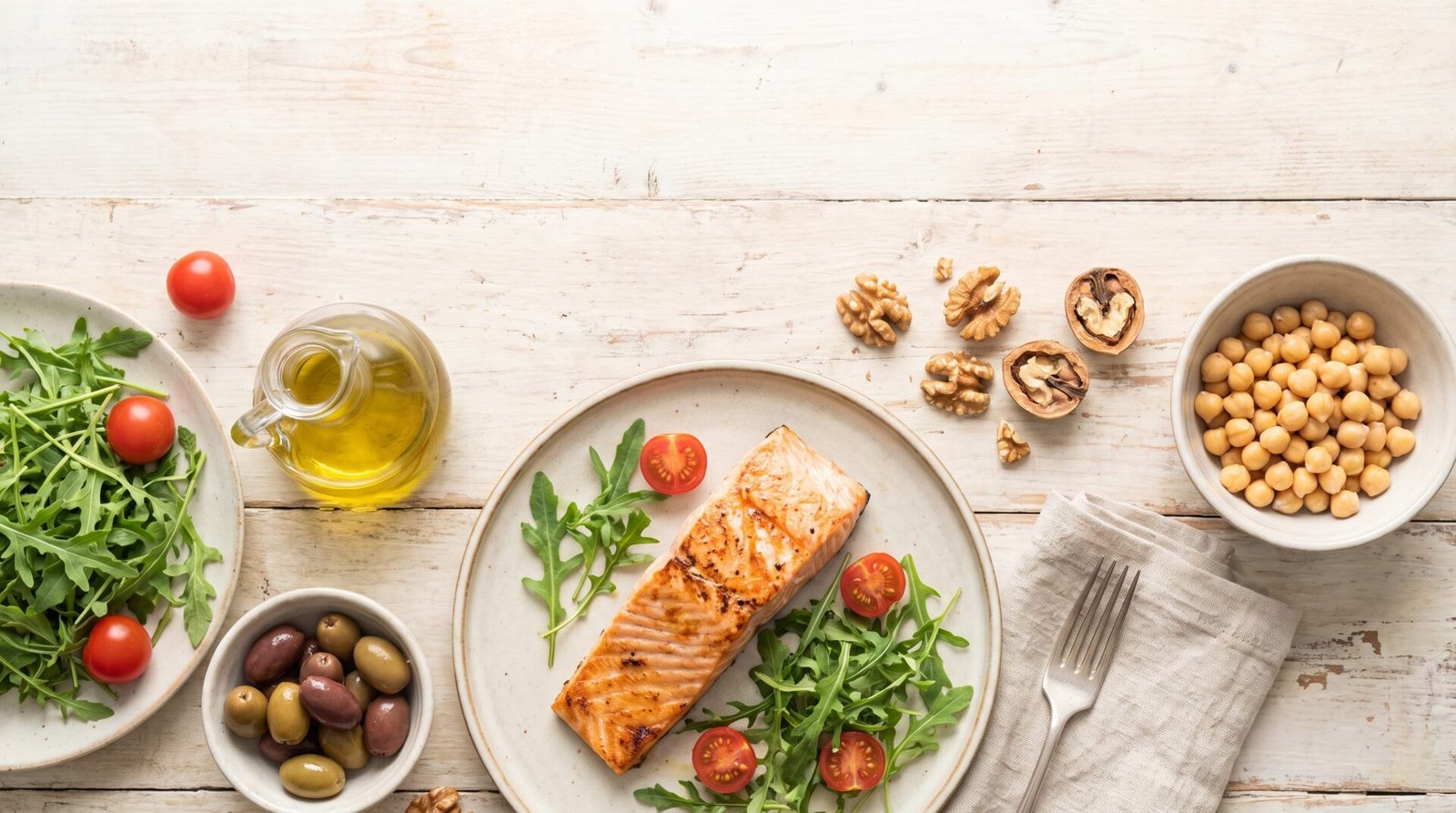
Quick answer: anti-inflammatory eating for joint health helps modestly at best: no food cures arthritis, and there is no “arthritis diet”. What the evidence does support is a Mediterranean-style eating pattern — randomised trials in rheumatoid arthritis have found reduced symptom severity, though researchers note the clinical significance is modest. For osteoarthritis, diet’s biggest proven lever is indirect but powerful: supporting weight management, where every pound lost removes roughly four pounds of load from each knee.
What this guide covers
- Why the diet advice differs by arthritis type
- The Mediterranean pattern and what trials found
- The strongest dietary lever for osteoarthritis
- What to eat more of
- What to limit — honestly
- Three claims that don’t hold up
- The gut connection
- Where to actually start
- Common questions
- The takeaway
Why the diet advice differs by arthritis type
Most “anti-inflammatory diet” content ignores a distinction that changes what you should expect.
Rheumatoid arthritis is an autoimmune disease driven by systemic inflammation — so an eating pattern that lowers inflammatory markers has a plausible, direct route to affecting symptoms. That is where the randomised diet trials have been done.
Osteoarthritis is primarily mechanical — cartilage wear under load, with a lower-grade inflammatory component. Diet’s clearest benefit here runs through body weight and joint loading rather than through inflammation directly.
If you are not sure which you have, the pattern of your symptoms is informative — our guide to early signs of arthritis covers the distinction, and it is worth establishing before changing your diet in pursuit of a specific effect.
The Mediterranean pattern and what trials found (Evidence: Moderate for RA, Limited for OA)
The Mediterranean pattern — vegetables, fruit, whole grains, legumes, fish, olive oil, nuts, with less red and processed meat — is the most studied anti-inflammatory eating approach.
Two randomised controlled trials are worth knowing. The MADEIRA trial tested a 12-week personalised Mediterranean diet plus physical activity promotion against usual care in women with rheumatoid arthritis; the intervention group finished with significantly lower symptom severity scores. The MEDRA trial tested a telehealth-delivered Mediterranean diet against health education over the same period.
A 2021 systematic review and meta-analysis of anti-inflammatory diets in rheumatoid arthritis found the Mediterranean pattern appeared more beneficial for pain than vegan or vegetarian approaches.
The honest caveat, stated by the researchers themselves: more recent cohort studies and trials have been equivocal, and while effects on symptom severity can reach statistical significance, their clinical significance is uncertain. Trials are also small — MADEIRA and MEDRA involved dozens of participants, not thousands — and diet studies cannot be properly blinded, since people know what they are eating.
So: a reasonable, low-risk pattern with genuine supporting trials, and real uncertainty about how much difference it makes to any individual.
The strongest dietary lever for osteoarthritis (Evidence: Strong)
For osteoarthritis, the best-evidenced thing diet can do is support gradual weight loss if you carry extra weight.
Biomechanics research found each pound of weight lost reduces knee load by roughly four pounds per step — accumulating to thousands of pounds of reduced load per mile walked. Research also indicates around a 10% body-weight reduction meaningfully improves pain, function and inflammatory markers compared with smaller losses.
This is why the Mediterranean pattern earns its place even where the direct anti-inflammatory effect is uncertain: it is a sustainable way of eating that supports weight management without extreme restriction. The full picture is in how to reduce joint pain naturally.
What to eat more of
- Oily fish — salmon, sardines, mackerel, herring. Omega-3s have the most supporting evidence in rheumatoid arthritis, where fish-oil supplementation may modestly reduce joint tenderness. Two portions weekly is a common target.
- Vegetables and fruit, across colours — variety matters more than any single “superfood”. Aim for range rather than chasing one ingredient.
- Extra virgin olive oil — the primary fat in every Mediterranean trial protocol.
- Legumes and whole grains — fibre, steady energy, and satiety that supports weight goals.
- Nuts and seeds — walnuts, almonds, flax. Also a practical source of magnesium.
What to limit — honestly
Ultra-processed foods, added sugar, excess alcohol and large amounts of processed meat are all reasonable to reduce — associated with higher inflammatory markers and, in most people’s diets, with excess calories too.
But note what that sentence does not say. It does not say these foods cause arthritis, or that removing them will resolve joint pain. Reducing them is sensible general nutrition that happens to support weight management — which is the mechanism that actually has strong evidence behind it for osteoarthritis.
One caveat specific to inflammatory arthritis: alcohol interacts with several arthritis medications, including methotrexate. If you are on treatment, that is a conversation with your clinician rather than a diet decision.
Three claims that don’t hold up
“Nightshades cause arthritis pain”
Tomatoes, peppers, aubergines and potatoes are widely blamed, with no good supporting evidence. Some individuals report sensitivity, and a personal elimination trial is harmless — but cutting a whole category of vegetables on a population-level claim that research does not support is a poor trade.
“Going gluten-free helps arthritis”
Unless you have coeliac disease or diagnosed gluten sensitivity, evidence does not support gluten avoidance for arthritis. Get coeliac disease tested before removing gluten — testing is unreliable once you have already stopped eating it.
“Apple cider vinegar reduces joint inflammation”
No credible evidence supports this. It is a persistent internet claim rather than a research finding, and undiluted vinegar can damage tooth enamel.
The gut connection
Research increasingly links the gut microbiome to systemic inflammation, and a fibre-diverse eating pattern shapes that community. This is genuinely interesting science and a legitimate reason to favour varied plant fibre — but it is still an emerging area, and claims that fixing your gut resolves arthritis run far ahead of the evidence.
If you want the current state of that field, our guide to the gut microbiome covers what is established versus speculative.
Where to actually start
Wholesale diet overhauls rarely survive contact with real life. Three changes that carry most of the benefit:
- Two portions of oily fish per week. The single most evidence-backed addition.
- Olive oil as your default cooking fat. One substitution, no willpower required.
- A vegetable or legume at every main meal. Increases fibre and satiety, which supports weight goals without counting anything.
Give it three months. Diet effects in trials were measured over 12 weeks, not days. And pair it with movement — diet plus activity is what the MADEIRA protocol actually tested, and low-impact exercise carries stronger evidence than any food.
Common questions
How long before diet changes affect joint pain?
The randomised trials ran 12 weeks. Allow at least three months, and expect gradual change rather than a noticeable switch.
Should I take fish oil instead of eating fish?
Fish-oil supplements have their best evidence in rheumatoid arthritis, with weaker support in osteoarthritis. Eating fish provides protein and micronutrients alongside omega-3s. If you take anticoagulants, check with a clinician before supplementing.
Can diet replace my arthritis medication?
No. For inflammatory arthritis in particular, medication prevents joint damage in a way diet does not. Never stop or reduce prescribed treatment without medical advice.
Is an elimination diet worth trying?
If you suspect a specific trigger, a structured short-term elimination with reintroduction can be informative — ideally with a dietitian. Long-term restriction of multiple food groups without a diagnosis carries real nutritional risk.
Does losing weight help even without exercise?
Yes — the load reduction is mechanical and applies regardless. Combining both produces better outcomes than either alone.
The takeaway
There is no arthritis diet, and no food is a treatment. A Mediterranean-style pattern has genuine randomised evidence in rheumatoid arthritis, with researchers themselves flagging that the clinical significance is modest. For osteoarthritis, diet’s strongest role is supporting weight management — where the evidence is strong. Start with oily fish twice a week, olive oil as your default fat, and a vegetable at every meal; ignore the nightshade and vinegar claims. Explore more in our Joint Health hub or browse all guides.
This article is for educational and informational purposes only and is not medical advice. Consult a qualified healthcare professional or registered dietitian before making significant dietary changes, particularly if you take arthritis medication, have coeliac disease, diabetes, kidney disease, or are pregnant. Never stop prescribed treatment without medical advice. Read about how we review content.
References
- MADEIRA: Mediterranean Diet and Physical Activity Nudges versus Usual Care in Women with Rheumatoid Arthritis. PMC9919932
- MEDRA: A randomised controlled trial of a Mediterranean Dietary Intervention for Adults with Rheumatoid Arthritis. PMC9126839
- A Brief Review of the Mediterranean Diet’s Role in Mediating Inflammation and in Management of Rheumatoid Arthritis. Perm J. PMC12703526
- Messier SP, et al. Weight loss reduces knee-joint loads in overweight and obese older adults with knee osteoarthritis. PubMed 15986358
- CDC — Self-Care for Arthritis. cdc.gov/arthritis/caring